The Secret History of Jane Eyre by John Pfordresher
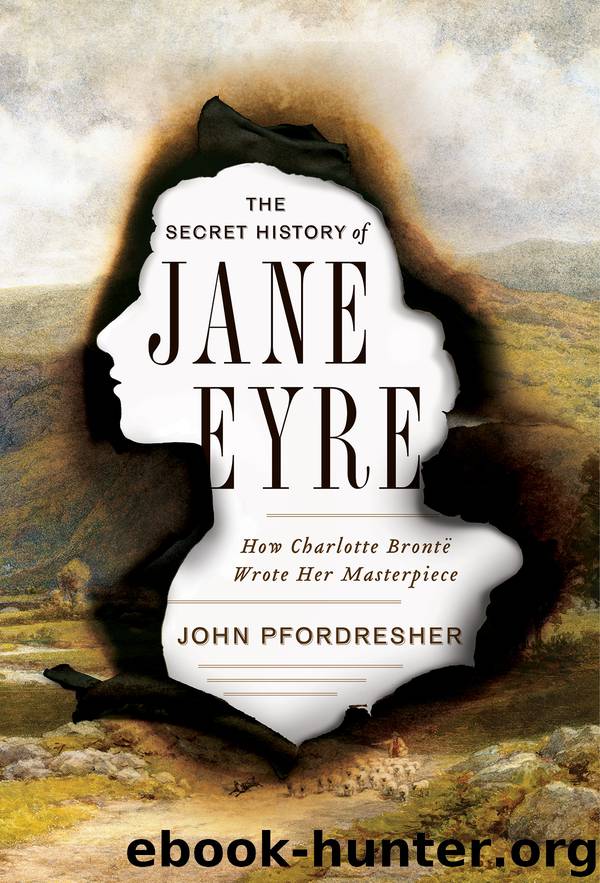
Author:John Pfordresher
Language: eng
Format: epub
Publisher: W. W. Norton & Company
Charlotte Brontë began her first, full-fledged novel during the winter of 1846. At the same time, Emily was working on Wuthering Heights and Anne on Agnes Grey. Charlotte’s first working-title for this book was The Master. Read in the light of Charlotte’s secret history, The Professor takes on particular significance in being, before Jane Eyre, Charlotte’s most recent exploration of the master motif. In it we find an exploration of the emotional dynamic between a male teacher and an unusual female student. Which is to say, it is all about Charlotte and M. Heger, and it constitutes her first effort to deal with her feelings for him.
Its narrator is an Englishman, William Crimsworth. As we have seen in Chapter Five, in choosing a male narrator, Brontë is following her regular practice during the years when she and Branwell wrote their Angrian saga. Then, Charlotte may have preferred to use the male voice because it seemed to put her on a more equal footing with her brother in their sibling rivalry for dominance. Further, like her preference for using a pseudonym, it deepens her disguise, allowing her to write about her secrets without detection.
Crimsworth takes employment as a teacher of English at a “Pensionnat de demoiselles” on the same Rue d’Isabelle occupied by Mme. Heger’s school and is directed by Mdlle. Reuter. Though Crimsworth, just as Charlotte Brontë, is dismayed by the worldliness of the young female students, all of this falls into insignificance as he begins to notice one of his students, the Swiss-English Mdl. Frances Henri: slight, “anxious and preoccupied,” with a “care-worn” forehead and a mouth that conveys surprise. This is Charlotte Brontë as she must have first appeared to M. Heger. In the novel she gives voice to what she imagines his first reactions to her were. It is also, of course, how Mr. Rochester first views Jane Eyre. In these scenes of emerging love the sequence from fact to fiction is invariable: the sad fact of Charlotte and Heger, followed by the fictional extrapolations of Frances and Crimsworth, Jane Eyre and Mr. Rochester. Except that in the first of the three the love is one-sided and hence thwarted, and, in the end, a source of a frustrated desire and pain that the novels seek to rectify. For Charlotte Brontë, writing became a way for imagination to liberate her from the trammels of painful reality—the “truth” that she aspired both to render and to transcend—and in these fictions Brontë and her readers find a way to something happier and more fulfilling.
Crimsworth soon learns that to earn her lessons, Frances must train other students in needlework, and while “she liked to learn, [she] hated to teach.” Insubordinate pupils ignore her pleas for order. A difficulty Frances shares with Charlotte Brontë during her years at Roe Head.
Then, one evening, Crimsworth sits down to read her first essay, what he names “the poor teacher’s manuscript,” expecting that now he would “see a glimpse of what she really is.” Indeed, that is exactly what happens.
Download
This site does not store any files on its server. We only index and link to content provided by other sites. Please contact the content providers to delete copyright contents if any and email us, we'll remove relevant links or contents immediately.
Still Me by Jojo Moyes(11277)
On the Yard (New York Review Books Classics) by Braly Malcolm(5528)
A Year in the Merde by Stephen Clarke(5441)
Eleanor Oliphant Is Completely Fine by Gail Honeyman(5286)
The Bookshop by Penelope Fitzgerald(3856)
How Music Works by David Byrne(3273)
Surprise Me by Kinsella Sophie(3116)
Pharaoh by Wilbur Smith(2994)
Why I Write by George Orwell(2958)
A Column of Fire by Ken Follett(2616)
Churchill by Paul Johnson(2589)
The Beach by Alex Garland(2565)
The Songlines by Bruce Chatwin(2563)
Aubrey–Maturin 02 - [1803-04] - Post Captain by Patrick O'Brian(2308)
Heartless by Mary Balogh(2263)
Elizabeth by Philippa Jones(2208)
Hitler by Ian Kershaw(2203)
Life of Elizabeth I by Alison Weir(2091)
Harry Potter and the Cursed Child by J. K. Rowling & John Tiffany & Jack Thorne(2068)
